
If only I had a crowbar, I think I hear headcrabs…
If only I had a crowbar, I think I hear headcrabs…

I thought this was a fantastic “how it’s made” video from post-war Britain.
Couple of highlights for me: (“Spoilers”, watch video first)
I’ve refined the earlier linkage design, and managed to simulate it in Phun! (Unfortunately while being easy to use and great for doing simulations, it doesn’t really rate as a proper CAD package; lacking the concept of ‘measurement’ for a start)
Video
Another advantage of this design, I think, is that when the bed is open there’s no gap between the bed and the wall. Many folding beds have this gap, and need a panel anchored to the inner edge of the bed to protect the user rolling down into the mechanism.
A few other challenges have arisen in designing this bed. Namely;
I need to fit a single bed into the spare bedroom. The best way to do this is probably a wall bed that folds up horizontally, but OUCH they’re expensive!
DIY it is then…
The most complex part is likely to be the hinge mechanism. In a horizontal fold there’s much less work and distance to lift, (Physics?) so I think I can get away with not needing shocks or springs to support the bed.
Another problem is that most folding beds are hinged at the unfolded bed’s height, so that the foldout action clears the rear of the unit. This raises the frame up by ~30cm, making the height of the unit much higher than the mattress width.
I’d love to be able to make some fancy 4-point linkage hinge, but that’s a little tough.
Instead, I think this hinge might work:
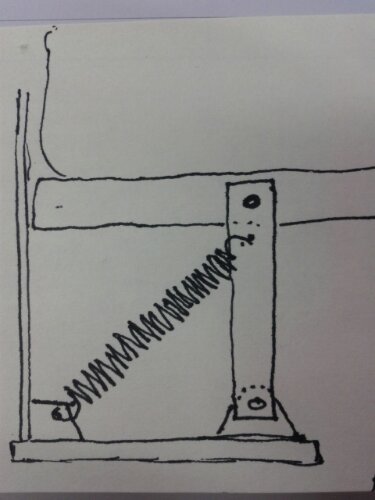
This is a side view of one of the two hinges, when the bed is opened. The wall side of the bed rests on the vertical strut shown, which pivots on the bed frame and the base. The spring allows the strut to hinge outward enough to let the mattress transition between horizontal and vertical, but pulls the strut back to vertical when the bed is fully open or closed. (It can’t go further ‘left’ as the bed frame runs up against the back of the unit.)
The outer side of the bed rests on its own braced legs.
What do you think? Good idea? Terrible?

There, I said it.
Every time I see a cool workshop tool or gadget, my response is either:
“I really need one of those!”
or:
“I wish I needed one of those!”
This definitely falls into the latter category, which makes me a little sad. One day, I’ll have something gigantic to sand, and hopefully I’ll remember this monster.
I wonder what it was originally built for?
(Of course, the proper answer to “What do you sand with it?” is “Whatever the hell I want.”)

It certainly turns ‘Keeping up with the Joneses’ on its head!
Just hope that your potential burglar isn’t some sort of spelling pedant, or he may just rob your house on general principle.

Apollo Exceed 20
Had enough of waiting for new FUJI bikes to come in, ended up buying a mid-range Apollo flat-bar road bike. Aluminium frame, carbon forks. Very light!
Aaand here comes the rain. More info when I actually get to ride it.
For some contract work, I am helping my former employer to connect their industrial control application to an OPC server, to read and write some array items. OPC is a de-facto standard for industrial data exchange, and for 99% of current installations, runs on top of Microsoft’s DCOM. (1, having anything to do with DCOM gets you a point) The application framework for some reason doesn’t support arrays… but enumerating things I don’t like about that framework will take all day.
The OPC server will sit there and accept DCOM connections of some kind, send back connections of some kind… and hopefully everything will work. If something goes wrong in this actually quite complicated process (likely), it doesn’t work. (very likely) And because of the mechanism by which it’s accessed, it’s damned hard to figure out why it doesn’t work. (2)
After trying several OPC client utilities and libraries, each of which fails to connect and read the values for some convoluted inscrutable reason, the Softing toolbox .NET library actually seems workable! (The process of separating the wheat from the chaff in the documentation and “example” code took a long while, but I can’t blame Microsoft for everything)
So, this code implements a simple array read/write command-line client. Tell it server name and item for reads, pass an additional value for writes. (Using hex strings so the industrial control application can easily parse/generate/pass them) Tested it against a few different items and values, no problem!
Using shellexec from within the application to call the utility (with the same parameters as before), and it connects to the server, reads the item, and fails with a item_not_connected error!
Something about the difference in environments between running from a command-line and running from inside the application is causing what appears to be a server problem. (3)
After some further investigation, the application is found to be running commands as a different user, nt authority/system . Is that why it fails? No idea. Windows won’t let me runas the command as that user without the password, so I can’t test that aspect. (4)
The saga continues…
